Liquid Empire: The Story of LA Water
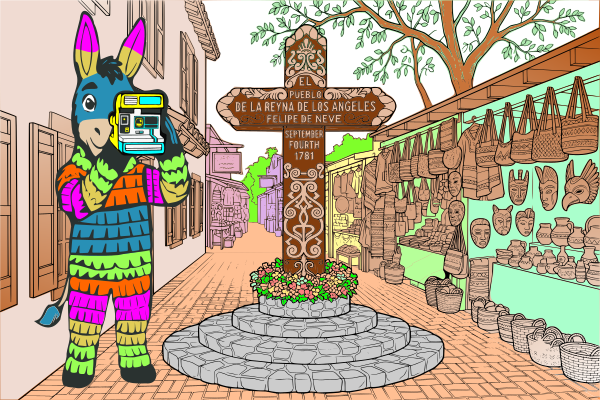
Los Angeles sits in a dry basin, yet it grew into one of the biggest cities on earth. This is how: from the Zanja Madre dug in 1781 to the Owens Valley water wars, the St. Francis Dam disaster, the concrete river and the water recycling of today.
1. The Living River & The Zanja Madre
Where: El Pueblo Historic Monument & Olvera Street
The Porciúncula: A Subterranean Oasis
Los Angeles was founded where it was because of a specific geological choke point. Where the Los Angeles River squeezes between the Santa Monica Mountains and the Elysian Hills, underground bedrock forces subterranean aquifers to the surface, maintaining a steady freshwater stream throughout rainless Mediterranean summers. The Gabrielino-Tongva established their primary settlement, Yanga, alongside these fertile banks.
The Mother Ditch (Zanja Madre)
Within weeks of founding the settlement in September 1781, Spanish settlers engineered the Zanja Madre. Dug by indigenous laborers with picks and shovels, this main trench pulled water from the river north of town, winding around the Elysian bluffs into the central Plaza. Smaller ditches (zanjas) branched off across the flats, irrigating vineyards, cornfields, and orchards that fed the early colony.
The Rule of the Zanjero
In a dry basin, water distribution was the most critical municipal task. The Zanjero held authority over dozens of miles of open dirt trenches, patrolled banks for blockages or dead livestock, and enforced strict watering schedules for farmers. The post commanded a higher municipal salary than the mayor or city council members.
Key dates
- Pre-1781: Gabrielino-Tongva settle the village of Yanga near the reliable underground water table of the Porciúncula River.
- 1781: Spanish settlers found El Pueblo de la Reina de los Ángeles, claiming absolute crown water rights over the basin.
- 1781 to 1800: Pobladores construct the Zanja Madre (Mother Ditch) to divert river water to plaza crops by gravity.
- 1854: The City of Los Angeles creates the official post of Zanjero (Water Overseer), making it the highest-paid city position.
People to know
- Felipe de Neve (Governor of Las Californias): Established the founding charter of Los Angeles, intentionally siting the Plaza on elevated land adjacent to the river to guarantee gravity-fed agricultural irrigation.
- The Zanjero (Municipal Water Overseer): The most influential official in early Los Angeles, entrusted with opening ditch gates, allocating daily water shares, and penalizing unauthorized diversion or fouling.
- William G. Dryden (Pioneer Water Judge & Builder): Constructed the town's first pressurized wooden water wheel and brick reservoir in the Plaza in 1857, tapping the river current to supply homes.
Buried Brick Conduit: In 2005, construction crews building the Metro Gold Line (now A Line) at Chinatown Station unearthed a fully intact, brick-vaulted underground section of the 1877 Zanja Madre.
2. Privatization, Wooden Pipes & The Birth of LADWP
Where: Historic Buena Vista Pumping Station (North Broadway & LA River)
The Wooden Pipe Experiment
Following a severe flood in 1868 that wrecked the municipal water wheel, the broke city government leased its water infrastructure to a private syndicate headed by Solomon Lazard. The company laid miles of water mains made from hollowed-out pine logs wrapped in iron wire. The pipes frequently rotted, clogged with mud and small fish, burst under high summer pressure, and leaked badly through downtown streets.
Mulholland: The Self-Taught Ditch Tender
In 1878, a 23-year-old Irish immigrant named William Mulholland arrived in Los Angeles and began working as a ditch tender for the private water company. He lived in a shack along the river, clearing brush, clearing debris, and studying mathematics, geology, and civil engineering manuals every night. His photographic memory and unmatched knowledge of the watershed propelled him to chief superintendent by 1886.
The 1902 Municipal Revolution
As the population grew from 11,000 in 1880 to over 100,000 by 1900, the private water monopoly failed to expand storage or improve fire protection. After years of bitter arbitration, civic reformers fought to reclaim public control. In 1902, Angelenos voted overwhelmingly to buy out the company for $2 million, establishing the municipal Bureau of Water Works and Supply and appointing Mulholland as its founding chief engineer.
Key dates
- 1868: The City leases municipal water distribution rights to the private Los Angeles City Water Company for 30 years.
- 1878: Young Irish immigrant William Mulholland takes a job as a ditch tender (zanjero) clearing weeds from the canals.
- 1898: The 30-year private lease expires, sparking a fierce legal battle over municipal versus private utility ownership.
- 1902: Voters approve municipal ownership by a 6-to-1 landslide, creating the Bureau of Water Works (today's LADWP).
People to know
- Prudent Beaudry (Downtown Developer & 13th Mayor): Early real estate developer who built high-pressure steam pumps to elevate river water onto the barren bluffs of Bunker Hill, making uphill living viable.
- Solomon Lazard (President, LA City Water Company): Downtown dry-goods merchant who organized the private syndicate that leased and operated the city's water infrastructure throughout the early boom decades.
- William Mulholland (Early Career) (Zanjero to Chief Superintendent): Self-educated laborer who lived in a small wooden shack along the river, studying hydraulics and geology by candlelight until he mastered the system.
Buena Vista Pumping Station: Constructed in the late 19th century near modern North Broadway, the Buena Vista station was the primary pumping facility lifting groundwater directly from the riverbed into city mains.
3. The Owens Valley Scheme & The Great Aqueduct
Where: The Cascades (Foothill Blvd & I-5, Sylmar)
The Secret Reconnaissance of 1904
By 1900, the expanding city was outgrowing the local Los Angeles River. Former mayor Fred Eaton convinced Chief Engineer William Mulholland that the Eastern Sierra snowmelt in Owens Valley held the answer. Posing as a cattle buyer and federal agent, Eaton systematically bought option contracts on ranches and riparian rights along the river, 250 miles north of downtown.
A Masterpiece of Gravity-Fed Engineering
Between 1908 and 1913, Mulholland directed the construction of the Los Angeles Aqueduct: 233 miles of open ditches, covered concrete conduits, 142 mountain tunnels, and massive riveted steel siphons traversing desert canyons like the Jawbone Siphon. Operating without a single powered pumping station, gravity alone delivered water across the Mojave Desert.
'There It Is. Take It.' (November 5, 1913)
On November 5, 1913, approximately 40,000 Angelenos gathered in the foothills of Sylmar at The Cascades. When Mulholland turned the handwheel opening the floodgates, Sierra water surged down the concrete chute into the San Fernando Valley. Mulholland gave a five-word dedication speech: 'There it is. Take it.'
Key dates
- 1904: Fred Eaton and William Mulholland scout the snowpack-fed Owens River basin east of the Sierra Nevada.
- 1905: LA voters approve a $1.5M bond to buy valley land after newspapers declare an impending water famine.
- 1908 to 1913: Over 3,900 workers build the 233-mile Los Angeles Aqueduct, relying entirely on gravity flow.
- Nov 5, 1913: Water cascades into the San Fernando Valley before 40,000 onlookers as Mulholland speaks his famous words.
People to know
- William Mulholland (Chief Engineer, Bureau of Water Works): Masterminded the construction of the world's longest aqueduct at the time, completing the monumental project on schedule and within budget.
- Fred Eaton (Former Mayor & Civil Engineer): Conceived the Owens River diversion scheme and quietly acquired extensive agricultural land and water rights throughout Inyo County.
- Joseph Lippincott (U.S. Reclamation Service Engineer): Federal engineer who shared confidential federal land surveys with Eaton and Mulholland while simultaneously on the city's payroll.
Viewing The Cascades: You can view the historic 1913 open spillway and the adjacent 1970 Second Aqueduct cascade running down the hillside directly from Foothill Boulevard in Sylmar.
4. The California Water Wars & Dust of Owens Lake
Where: Alabama Gates Spillway (Lone Pine, Inyo County)
The Occupation of Alabama Gates (1924)
During a severe drought in the 1920s, Los Angeles diverted nearly all surface and well water from the Owens River, leaving local farms parched. On November 16, 1924, a caravan of armed ranchers marched on the Alabama Gates spillway north of Lone Pine, lowered the massive iron gate, and diverted the entire flow out of the aqueduct back into the riverbed. The protest turned into a four-day community picnic, complete with barbecue and brass bands.
Dynamite in the Desert
Between 1926 and 1927, the conflict escalated into low-intensity guerrilla warfare. Siphons, conduits, and power lines along the aqueduct were dynamited 17 times. The City of Los Angeles dispatched private armed detectives, stationed snipers with searchlights along the mountain channels, and patrolled canal roads in armored cars fitted with machine guns.
The Disappearance of Owens Lake
Prior to the aqueduct, Owens Lake was a 100-square-mile navigable body of water with commercial steamships. By 1926, the complete diversion of its feeder streams left an alkaline salt flat. Dry winds whipped up blinding clouds of carcinogenic PM-10 dust, creating an environmental crisis that would take nearly a century and billions of dollars to remediate.
Key dates
- 1924: Over 700 local residents seize the Alabama Gates spillway, diverting aqueduct water back into the river.
- 1926: Owens Lake dries up completely, creating one of the worst sources of toxic dust pollution in North America.
- 1927: Armed ranchers dynamite aqueduct siphons 17 times; LA sends armored patrol cars with armed guards.
- 1927: The Watterson brothers' banking syndicate collapses, bankrupting valley resistance.
People to know
- Mark & Wilfred Watterson (Inyo County Bankers & Leaders): Brothers who organized valley resistance against LADWP until their financial empire collapsed under charges of embezzlement.
- Mary Austin (Author & Environmental Chronicler): Celebrated writer whose classic book 'The Land of Little Rain' documented the cultural and ecological transformation of Owens Valley.
- Sheriff J. Frank McKay (Inyo County Sheriff): Local lawman who openly sympathized with the protesting ranchers, refusing to deploy tear gas or arrest citizens occupying the diversion gates.
Owens Lake Dust Mitigation: Since 2000, LADWP has spent over $2.5 billion installing gravel blankets, native vegetation, and shallow flooding across the dry lake bed to control dust storms.
5. The St. Francis Dam Collapse & Mulholland's Fall
Where: San Francisquito Canyon (Santa Clarita, CA)
The 12-Billion-Gallon Reservoir
To buffer against aqueduct bombings in Owens Valley, Mulholland designed the St. Francis Dam in San Francisquito Canyon north of modern Santa Clarita. To expand capacity, Mulholland raised the dam's height twice during construction without widening its base. Unknown to engineers at the time, the eastern abutment rested against an ancient prehistoric landslide, and the western flank was anchored to soft, water-soluble red conglomerate rock.
Midnight Deluge: The Santa Clara Valley
At 11:57 PM on March 12, 1928, the structure gave way. A 140-foot wall of water crashed down the canyon, sweeping away the heavy concrete powerhouse and its workers. Traveling at 18 miles per hour, the surge entered the Santa Clara River, destroying towns including Castaic, Piru, Fillmore, Santa Paula, and Saticoy before emptying into the Pacific Ocean near Ventura at 5:30 AM. Over 400 lives were lost.
'I Envy the Dead' (The Inquest)
At the coroner's inquest, an emotionally broken Mulholland testified: 'Don't blame anyone else, you just fasten it on me. If there was an error in human judgment, I was the human, and I won't try to fasten it on anyone else. The only ones I envy about this whole thing are the ones who are dead.' The tragedy ended his career, led to the creation of California's strict Dam Safety Division, and reshaped modern civil engineering oversight.
Key dates
- 1926: LADWP completes the 185-foot curved concrete St. Francis Dam to store 12 billion gallons of reserve water.
- March 12, 1928 (Noon): Mulholland inspects muddy seepage leaks at the base and declares the structure sound.
- March 12, 1928 (11:57 PM): The dam collapses catastrophically, sending a 140-foot wall of water down the canyon.
- 1929: Mulholland resigns in grief and public disgrace after accepting full responsibility at the inquest.
People to know
- William Mulholland (Chief Engineer & Dam Designer): His failure to detect unstable paleolithic rock formations and his unilateral decisions to raise the dam height led to Southern California's worst civil engineering disaster.
- Tony Harnischfeger (Dam Keeper): Lived in a cabin beneath the structure; alerted Mulholland to muddy leaks on the morning of March 12 and died alongside his family when the dam burst at midnight.
- Thornton Edwards (Santa Paula Motorcycle Officer): The 'Midnight Rider' who sped ahead of the 20-foot flood crest in darkness with sirens wailing, saving hundreds of sleeping valley residents.
National Memorial Site: In 2019, Congress designated the ruins in San Francisquito Canyon as the Saint Francis Dam Disaster National Memorial, preserving the surviving concrete fragments.
6. Taming the Colorado & The Metropolitan Water District
Where: Lake Mathews Terminal Reservoir (Riverside County)
Beyond Mulholland: The Regional MWD Coalition
Following the St. Francis disaster, Los Angeles abandoned unilateral aqueduct construction in favor of regional cooperation. In 1928, the state established the Metropolitan Water District of Southern California (MWD). Thirteen charter cities, including Los Angeles, Pasadena, Glendale, Burbank, Anaheim, and Santa Monica, banded together to secure water from the Colorado River, over 240 miles east.
Lifting Water 1,617 Feet Across the Desert
Unlike the gravity-fed Owens Valley aqueduct, the Colorado River Aqueduct faced the jagged desert ranges of eastern California. Chief Engineer Frank Weymouth solved the challenge with five mammoth pumping stations powered by hydroelectricity from Hoover Dam. The pumps hoisted billions of gallons of water a total of 1,617 vertical feet over mountain ridges.
Depression-Era Lifeline & Post-War Expansion
Funded by a $220 million bond measure in 1931, the project employed more than 35,000 workers during the height of the Great Depression. When deliveries began in 1941 at Lake Mathews, the system provided the indispensable freshwater foundation that supported Southern California's World War II aerospace boom and post-war suburban growth.
Key dates
- 1928: The California Legislature charters the Metropolitan Water District of Southern California (MWD).
- 1931: Southern California voters pass a $220M bond during the Great Depression to build the Colorado River Aqueduct.
- 1939: Crews complete 242 miles of desert conduits and five massive mountain pumping plants.
- 1941: The first Colorado River water reaches the Lake Mathews terminal reservoir in Riverside County.
People to know
- William P. Whitsett (First Chairman of the MWD Board): San Fernando Valley developer who built the multi-city political coalition uniting 13 founding cities across Southern California to finance regional water imports.
- Frank E. Weymouth (Chief Engineer & General Manager, MWD): Engineered the Colorado River Aqueduct, designing high-lift pumping systems that raised water over desert mountain passes.
- Herbert Hoover (Secretary of Commerce & U.S. President): Brokered the multi-state 1922 Colorado River Compact and championed the construction of Boulder Dam (Hoover Dam).
The Colorado River Compact: The 1922 interstate compact divided river water based on unusually wet historical years, causing long-term structural overallocation that Western states continue to negotiate today.
7. Paving the River & The State Water Project
Where: Glendale Narrows (LA River Bike Path & Riverdale Ave)
The 1938 Cataclysm & Channelization
In early March 1938, consecutive storms dumped torrential rains across the San Gabriel Mountains. The Los Angeles River burst its banks, killing 115 people and cutting off city communications. Responding to civic panic, the federal government tasked the U.S. Army Corps of Engineers with flood control. Over two decades, engineers encased 51 of the river's 52 miles in a concrete channel, transforming a natural willow-lined waterway into a storm drain.
The State Water Project: The Longest Straw
Under Governor Pat Brown in 1960, California voters authorized the State Water Project. The centerpiece was the 444-mile California Aqueduct, carrying runoff from the snow-fed Feather River and the Sacramento-San Joaquin Delta straight down the Central Valley to supply Southern California urban centers.
The Tehachapi Lift: Moving Rivers Over Mountains
Reaching Southern California required crossing the formidable Tehachapi Mountains. In 1973, the state brought online the Edmonston Pumping Plant at the southern edge of the Central Valley. Operating 80,000-horsepower motor units, the plant lifts water 1,926 vertical feet in a single push, the highest single-lift water pump system on Earth.
Key dates
- 1938: The Great Flood of 1938 kills 115 people and causes massive property destruction across LA County.
- 1938 to 1960: The U.S. Army Corps of Engineers encases 51 miles of the Los Angeles River in 3.5 million barrels of concrete.
- 1960: California voters pass the Burns-Porter Act funding the statewide California Aqueduct.
- 1973: The Edmonston Pumping Plant begins lifting Northern California water 1,926 feet over the Tehachapi Mountains.
People to know
- Major Theodore Wyman (U.S. Army Corps of Engineers District Chief): Directed the systematic channelization and concrete paving of the Los Angeles River to eliminate urban flood risks.
- Edmund G. 'Pat' Brown (Governor of California): Championed the 444-mile California Aqueduct and State Water Project, moving snowmelt from the Sacramento Delta to Southern California.
- Arthur Powell Davis (Reclamation Engineer): Pioneered early master planning for comprehensive statewide river capture and multi-basin canal transfers.
The Glendale Narrows Soft Bottom: In the Glendale Narrows section of the LA River, the groundwater table was so high that concrete could not be poured; this left a natural soft riverbed with lush islands, ducks, and tall willows.
8. Mono Lake, Conservation & The River Revival
Where: LA State Historic Park & Taylor Yard (Bowtie Parcel)
The Battle for Mono Lake & The Public Trust
When LADWP expanded diversions in 1970, Mono Lake dropped over 40 vertical feet, exposing land bridges that let predators reach gull rookeries. Led by biologist David Gaines, conservationists sued under the ancient Roman legal principle of the Public Trust Doctrine. In 1983, the California Supreme Court ruled that the state has an ongoing duty to protect navigable waterways and wildlife habitats, forcing LA to reduce diversions.
Lewis MacAdams & The River Renaissance
In 1986, poet and activist Lewis MacAdams and friends cut a hole in the chain-link fence along the concrete river, declaring it a living ecosystem. He founded Friends of the Los Angeles River (FoLAR), advocating for bike paths, public parks, kayak recreation, and green wetlands. Today, master plans are revitalizing riverfront sites like the Taylor Yard Bowtie parcel.
Closing the Loop: 100% Water Recycling
Facing recurrent Sierra droughts and Colorado River deficits, Los Angeles is shifting from water importation to local resilience. Projects like Pure Water Southern California and LADWP's Operation NEXT are retrofitting the Hyperion Water Reclamation Plant to purify 100% of municipal wastewater, transforming LA from a water-dependent desert outpost into a circular water economy.
Key dates
- 1970: LADWP completes the Second LA Aqueduct, increasing diversions from streams feeding Mono Lake.
- 1979: The Mono Lake Committee files a historic lawsuit to stop ecological destruction of the saline lake.
- 1983: The California Supreme Court issues the landmark Public Trust Doctrine ruling in National Audubon Society v. Superior Court.
- 1986: Poet Lewis MacAdams founds Friends of the Los Angeles River (FoLAR), sparking the movement to revitalize the concrete channel.
People to know
- David Gaines (Biologist & Mono Lake Defender): Co-founded the Mono Lake Committee in 1978, using grassroots science to demonstrate how stream diversions threatened millions of migratory birds.
- Dorothy Green (Environmental Leader & LADWP Commissioner): Founding president of Heal the Bay who championed urban stormwater capture, water recycling, and coastal restoration.
- Lewis MacAdams (Poet & Founder of FoLAR): Broke through river fences with wire cutters in 1986, creating a decades-long movement to naturalize the concrete river and return native wildlife.
Pure Water Southern California: When completed, the regional water recycling facility in Carson will produce 150 million gallons of purified drinking water every single day, enough for 1.5 million residents.
Want to see where this story started?
The free walking tour of Downtown LA with MarlonWalksLA (2.5 hours, tip-based) ends at Olvera Street, where the Zanja Madre once ran. Book the free tour or book it in Spanish. More stories: LA history.
Quick answers
What was the Zanja Madre?
The "Mother Ditch," LA's first canal. Settlers dug it right after the town was founded in 1781 to bring river water to the plaza and the farms around it.
When did the Los Angeles Aqueduct open?
On November 5, 1913. About 40,000 people watched Owens Valley water pour down the Cascades in Sylmar, and William Mulholland said: "There it is. Take it."
What were the California water wars?
Owens Valley ranchers fought back after LA took their river. In 1924 they seized the Alabama Gates spillway, and in 1926 and 1927 the aqueduct was dynamited 17 times.
Why is the LA River made of concrete?
After the 1938 flood killed 115 people, the U.S. Army Corps of Engineers encased 51 of the river's 52 miles in concrete to control floods.