How LA Learned to Move
Before the freeways, Los Angeles had the biggest electric rail network on earth. This is how the city learned to move: Tongva trade paths, the railroad wars, the Red Cars, the freeway boom and the Metro.
1. Native Trails, Hide Ships & Port San Pedro
Where: San Pedro Bay & Historic Alameda Trade Corridor
Tongva Trade Paths: The Geological Blueprints
Long before asphalt or steel rails were laid, the geography of Los Angeles was dictated by nature and its first inhabitants. The Gabrielino-Tongva people developed intricate networks of footpaths that followed riverbeds, natural mountain passes, and flat coastal plains to trade sea salt, abalone shells, and obsidian between inland settlements and coastal villages like Yanga and Suangna. Modern thoroughfares like Wilshire Boulevard and the Arroyo Seco corridor follow these exact prehistoric foot trails.
The 'Bay of Smokes' & The Hide-and-Tallow Trade
During the Spanish and Mexican eras, the remote outpost of Los Angeles had no natural deep-water harbor. Trading vessels anchored miles offshore in the shallow mudflats of San Pedro, then known as 'The Bay of Smokes' for the brush fires burning along the hills. Heavy wooden carretas (ox carts) made grueling two-day treks through dust and mud, hauling stiff dried cowhides ('California banknotes') and cow tallow down to the shore to trade for manufactured goods with Boston merchant ships.
Phineas Banning & The First Railroad (1869)
Recognizing that Los Angeles would remain an isolated cattle town without rapid ocean access, entrepreneur Phineas Banning set out to revolutionize regional shipping. In October 1869, he opened the Los Angeles & San Pedro Railroad, a 21-mile line running from Wilmington directly into downtown Los Angeles. The train slashed travel time from an eight-hour bone-jarring stagecoach journey down to just 60 minutes, unleashing downtown's commercial wholesale economy.
The 'Free Harbor Fight' of the 1890s
By the late 19th century, rail baron Collis P. Huntington sought to monopolize all Pacific shipping by building the 'Long Wharf' in Santa Monica. A bitter decade-long political struggle erupted between Huntington’s railroad syndicate and Los Angeles civic leaders led by Senator Stephen M. White. In 1899, the federal government officially selected San Pedro as the site for a taxpayer-funded, breakwater-protected deep-water port, ensuring the waterfront remained open to public commerce.
Key dates
- Pre-1769: Gabrielino-Tongva establish trade footpaths between inland villages and the Pacific coast.
- 1830s: San Pedro serves as the rough coastal anchorage for Mexican hide and tallow trading ships.
- 1869: Phineas Banning opens the Los Angeles & San Pedro Railroad, Southern California's first rail line.
- 1899: The 'Free Harbor Fight' concludes as San Pedro is selected over Santa Monica as LA's official seaport.
People to know
- Phineas Banning (Father of the Port of Los Angeles): Delaware entrepreneur and stagecoach operator who dredged the harbor channels and constructed Southern California's very first commercial railroad in 1869.
- Don Manuel Domínguez (Californio Ranchero & Statesman): Signer of the California Constitution and owner of the vast 75,000-acre Rancho San Pedro, who granted crucial rights-of-way for early stage and rail routes.
- Stephen M. White (U.S. Senator ('Harbor Defender')): Fought Collis Huntington's Southern Pacific Railroad in Congress to ensure San Pedro remained a free, publicly owned deep-water harbor.
America's Busiest Port: Today, the Port of Los Angeles and adjacent Port of Long Beach form the largest port complex in the Western Hemisphere, handling over 30% of all containerized ocean cargo entering the United States.
2. The Iron Horse Invasion & The $1 Fare War
Where: Historic River Station Yard (Now LA State Historic Park)
The Southern Pacific Ultimatum (1876)
In the 1870s, the transcontinental railroad transformed the American West, but Los Angeles was initially bypassed by the central overland route through Sacramento. When the Southern Pacific Railroad began building south, rail barons demanded a steep ransom: the city had to hand over $600,000 in municipal bonds and surrender ownership of Banning's San Pedro rail line, or the railroad would bypass LA in favor of San Diego. Downtown voters reluctantly approved the measure to secure the city's future.
The Golden Spike at Lang Station
On September 5, 1876, Southern Pacific President Charles Crocker drove a ceremonial golden spike at Lang Station in Soledad Canyon. Over 3,000 Chinese laborers had spent months blasting through solid granite to carve the 6,966-foot San Fernando Tunnel. The completion linked Los Angeles directly to San Francisco and the national railway grid for the first time in history.
The Santa Fe Breakthrough (1885)
For nearly a decade, Southern Pacific exercised a ruthless freight and passenger monopoly, charging exorbitant rates that choked local agriculture. In 1885, the Atchison, Topeka & Santa Fe Railway broke through the Cajon Pass, establishing a competing transcontinental terminus at the River Station freight yards north of downtown. The monopoly was shattered, igniting immediate corporate warfare.
The $1 Fare War & The Great Land Rush
In March 1887, both railroads launched a fierce price war to capture prospective settlers. Fares from Kansas City and Chicago to Los Angeles dropped from $125 down to $25, then $5, and briefly to $1 for a single day. Train cars overflowed with tens of thousands of homesteaders, health-seekers, and speculators. Over 100,000 settlers arrived in a single year, triggering the 'Boom of the Eighties' and converting dry scrubland into suburban subdivisions.
Key dates
- 1876: Southern Pacific drives the Golden Spike at Lang Station in Soledad Canyon.
- 1885: The Santa Fe Railway completes its transcontinental line into Southern California.
- 1887: Cutthroat rate war slashes train tickets from Chicago to LA to $1 for a single day.
- 1889: The population explosion forces the split of Orange County from Los Angeles County.
People to know
- Collis P. Huntington (Southern Pacific Rail Baron): One of the 'Big Four' industrialists who demanded massive municipal subsidies and land grants under threat of bypassing Los Angeles entirely.
- William Barstow Strong (President of the Santa Fe Railway): Aggressive railroad builder who broke Southern Pacific's regional monopoly by pushing tracks across the Mojave Desert and Cajon Pass into LA.
- Harris Newmark (Pioneer Merchant & Civic Leader): Downtown merchant who rallied local voters to approve rail bond subsidies, preventing Los Angeles from becoming a forgotten agricultural siding.
Visit the River Station: Walk through modern Los Angeles State Historic Park (just north of Chinatown) to see the footprint of the original 1876 rail depot where thousands of transcontinental passengers first set foot in LA.
3. The Electric Streetcar Empire: Red Cars vs. Yellow Cars
Where: Subway Terminal Building & 4th/Hill Street
The Dual Rail System: Red vs. Yellow
By the 1920s, Los Angeles boasted the most advanced, extensive electric mass transit network on earth. The transit network operated on a complementary two-tier model:
• The Yellow Cars (Los Angeles Railway): Narrow-gauge streetcars running down the center of city avenues, handling dense, short-distance trips within Downtown, Boyle Heights, and South LA.
• The Red Cars (Pacific Electric): Standard-gauge, high-speed interurban trains that connected DTLA to outlying cities across four counties, from San Fernando and Pasadena down to Long Beach and Redlands.
The Loss-Leader Real Estate Blueprint
The genius behind Henry Huntington’s Pacific Electric was an unconventional business model: the streetcars were built to lose money. Huntington made his millions not on 5-cent passenger fares, but through the Huntington Land & Improvement Company. His syndicate purchased barren orange groves and desert acreage, extended Red Car electric tracks straight into the dirt, and then sold subdivided suburban house lots at massive profits to new arrivals.
The 1925 Subway Terminal & Belmont Tunnel
As private automobiles crowded Downtown Los Angeles streets in the 1920s, surface streetcars faced paralyzing gridlock. To bypass street-level congestion, Pacific Electric constructed the Belmont Tunnel and the monumental 12-story Subway Terminal Building at 4th and Hill Streets. Commuters entered underground marble concourses and boarded electric trains that sped through a subterranean tube directly to Glendale and Hollywood.
Mount Lowe & Transit Tourism
The electric railway was also an engine of leisure and tourism. Pacific Electric ran scenic mountain routes like the Mount Lowe Railway in the San Gabriel Mountains, where vacationers rode electric cars and cable funiculars up sheer granite cliffs to mountaintop resort hotels, dance pavilions, and astronomical observatories overlooking the entire valley.
Key dates
- 1901: Henry Huntington incorporates the Pacific Electric Railway ('Red Cars').
- 1911: The 'Great Merger' consolidates dozens of independent streetcar lines under Pacific Electric.
- 1925: The Subway Terminal Building and Belmont Tunnel open to alleviate DTLA traffic jams.
- 1940s: The combined system operates over 1,100 miles of track carrying 250+ million annual riders.
People to know
- Henry E. Huntington (Founder of Pacific Electric): Visionary tycoon who built the world's largest electric interurban railway, using cheap passenger transit to sell suburban real estate subdivisions.
- General Moses Sherman (Streetcar Developer): Pioneered early electric traction lines linking Downtown to Santa Monica and the San Fernando Valley (Sherman Oaks namesake).
- Isaias W. Hellman (Master Financier): President of Farmers & Merchants Bank who provided the vast syndicated capital required to electrify Southern California's transit network.
The Surviving Subway Terminal: The grand 1925 Subway Terminal Building at 4th & Hill still stands today, beautifully restored as the Metro 417 luxury apartments, resting directly above the historic underground train vaults.
4. The Automobile Takeover & America's First Freeway
Where: Arroyo Seco Parkway (CA-110) & Figueroa Corridor
1925: The World’s Car Capital
By 1925, Los Angeles owned more automobiles per capita than any place on Earth: 1 car for every 3 residents, compared to a national average of 1 in 7. Year-round Mediterranean sunshine, flat wide valleys, abundant local petroleum from the 1892 oil strike, and cheap suburban tract housing made the personal motorcar an essential instrument of daily Californian life.
Arroyo Seco Parkway (1940): America's First Freeway
On December 30, 1940, the state opened the six-mile Arroyo Seco Parkway (now CA-110) linking Pasadena to DTLA. It was the first fully grade-separated, controlled-access highway in the United States. Engineered with banked asphalt turns, concrete center dividers, and an intended top speed limit of 45 mph, it cut driving time between the two cities from 35 minutes down to just 12.
Programmatic Architecture & Speed Signage
As drivers zipped past storefronts at 40 miles per hour, standard Victorian signs became unreadable. Business owners invented programmatic (novelty) architecture: constructing entire buildings shaped like giant hot dogs (Tail o' the Pup), brown derbies (The Brown Derby), tamales, and coffee pots so passing motorists could instantly identify goods from behind the steering wheel.
The Drive-Thru Revolution & In-N-Out (1948)
Car culture changed the culinary landscape. While traditional drive-ins employed carhops on roller skates who delivered food trays to car windows, Harry and Esther Snyder opened California’s very first drive-thru in Baldwin Park in 1948: In-N-Out Burger. Harry engineered a breakthrough two-way intercom speaker box, allowing drivers to order, pay, and grab food without ever stepping out of their vehicle.
Key dates
- 1925: LA leads the world in per-capita car ownership (1 car per 3 residents).
- 1930s: Drive-in markets, motels, and programmatic architecture sprout across roadside corridors.
- 1940: The Arroyo Seco Parkway (CA-110) opens between Pasadena and Downtown LA.
- 1948: Harry and Esther Snyder open California's first drive-thru burger stand with intercoms in Baldwin Park.
People to know
- Harry & Esther Snyder (In-N-Out Burger Founders): Pioneered car-culture quick service in 1948 by introducing a revolutionary two-way intercom speaker box, eliminating carhops.
- Spencer V. Cortelyou (Chief Highway Engineer): State highway engineer who designed the Arroyo Seco Parkway, engineering banked curves, grade separations, and paved concrete bypasses.
- Wayne McAllister (Googie & Drive-in Architect): Renowned mid-century architect who designed streamline drive-in restaurants, circular carports, and eye-catching neon roadside diners.
Drive-Thru Innovation: Harry Snyder's 1948 two-way intercom speaker is the direct prototype used by every fast-food drive-thru lane across the globe today.
5. The Streetcar Conspiracy & The Last Red Car
Where: Watts Station (Surviving 1904 Red Car Depot)
The Formation of National City Lines
In 1936, a holding company called National City Lines began quietly buying up electric streetcar networks in over 45 American cities. The company was secretly funded by corporate heavyweights with direct financial interests in automobile travel: General Motors (diesel bus manufacturer), Firestone Tire (rubber supplier), Standard Oil of California (diesel fuel refiner), and Mack Trucks.
The 1949 Federal Antitrust Conviction
In the landmark federal case United States v. National City Lines (1949), the United States Department of Justice prosecuted GM and its partners. The federal jury found the corporate syndicate guilty of criminal antitrust conspiracy for conspiring to eliminate electric rail competition and monopolize the sale of diesel buses and petroleum products. Despite the conviction, the court issued only symbolic penalties: GM was fined a nominal $5,000, and individual executives were fined $1.
The Real Estate Shift & Deferred Maintenance
While the corporate conspiracy accelerated the streetcar's demise, economic realities played a parallel role. Because tracks ran down the middle of public streets, streetcars became trapped in automobile traffic. As ridership declined, maintenance was deferred. Moreover, Huntington's land syndicates had already sold off their suburban real estate, removing the corporate subsidies that had originally kept passenger fares artificially cheap.
April 9, 1961: The End of an Era
On the morning of April 9, 1961, Pacific Electric Car #1543 made its ceremonial final journey from Downtown LA to Long Beach, decorated with black banners reading 'Farewell to the Red Cars.' The tracks were swiftly paved over, overhead copper electrical wires were cut down, and Los Angeles would remain completely devoid of rail transit for nearly 30 years.
Key dates
- 1936: National City Lines is founded by GM, Firestone, and Standard Oil to purchase transit systems.
- 1949: Federal antitrust conviction of General Motors in United States v. National City Lines.
- 1953: Pacific Electric sells its passenger lines to Metropolitan Coach Lines.
- April 9, 1961: The final Red Car completes its last run from DTLA to Long Beach.
People to know
- Alfred P. Sloan (President of General Motors): GM chief who spearheaded corporate diversification into diesel bus manufacturing and orchestrated investments into private transit holding firms.
- Judge William J. Campbell (Federal District Judge): Presided over the 1949 Chicago antitrust trial that found General Motors, Firestone, and Standard Oil guilty of monopolizing bus transit equipment.
- Jesse L. Haugh (President of Metropolitan Coach Lines): Transit executive who systematically converted Southern California's remaining rail passenger corridors into diesel bus operations.
Watts Station Landmark: Watts Station (built 1904) was the only commercial building on the street to survive the 1965 Watts uprising untouched; it stands today fully preserved as a historic passenger rail monument.
6. The Freeway Metropolis & Divided Communities
Where: The 'Four-Level' Interchange (US-101 & CA-110 Junction)
The 'Four-Level' Interchange (The Stack)
Dedicated in 1953, the famous 'Four-Level' Interchange in DTLA was the world's very first four-tier highway stack. Connecting the 101 Hollywood Freeway with the 110 Harbor/Pasadena Freeway, it stood as a marvel of mid-century civil engineering. Its sweeping concrete overpasses became an international symbol of post-war modernity, appearing in hundreds of films and television title cards.
The Fracturing of East Los Angeles
Freeway routes were not distributed equally. While affluent neighborhoods like Beverly Hills and South Pasadena used political clout and lawsuits to block proposed highway routes (such as the Beverly Hills Freeway and the 710 extension), state highway engineers routed multiple massive corridors straight through working-class Latino and minority communities. Boyle Heights and East LA were sliced by six distinct freeways (I-5, I-10, US-101, CA-60, CA-110, I-710), displacing over 10,000 residents and severing historic neighborhood walking corridors.
Chavez Ravine & Urban Displacement
During the same post-war decades, the Mexican-American communities of La Loma, Palo Verde, and Bishop in Chavez Ravine were cleared under eminent domain for planned public housing. When the housing project was canceled, the city transferred the leveled land to Walter O'Malley to construct Dodger Stadium in 1962, cementing one of the most painful displacement struggles in the city's civic memory.
The Smog Crisis & The Birth of Emissions Law
By the late 1950s, Los Angeles was choked by thick, eye-stinging photochemical smog that obscured the San Gabriel Mountains for weeks at a time. In 1952, Caltech biochemist Dr. Arie Haagen-Smit proved that automotive tailpipe emissions reacted with sunlight to create ground-level ozone. This scientific breakthrough forced California to establish the California Air Resources Board (CARB) and mandate the world’s first vehicular catalytic converters.
Key dates
- 1947: California passes the Collier-Burns Highway Act to fund statewide freeways.
- 1953: The world's first multi-tier 'Four-Level' Stack opens in Downtown LA.
- 1956: President Eisenhower signs the Federal-Aid Highway Act, funding 90% of interstate construction.
- 1970: Chicano moratorium activists march down Whittier Boulevard protesting war and urban neglect.
People to know
- Edward R. Roybal (Pioneering City Councilman & Congressman): LA's first Mexican-American councilman since 1881, who fought to protect Eastside neighborhoods from being fractured by highway construction.
- Abe Lincoln (State Highway Bridge Engineer): Lead civil engineer who designed the 1953 Four-Level stack interchange, pioneering pre-stressed concrete overpass construction.
- Dr. Arie Haagen-Smit (Caltech Biochemist): Discovered the chemical formula of photochemical smog in 1952, proving car exhaust was the primary source of LA's toxic air basin pollution.
The Stack Overlook: Stand on the Grand Avenue pedestrian bridge just north of Temple Street to capture the classic postcard shot of the Four-Level stack interchange framed by palm trees.
7. Aviation Gateway: Mines Field to LAX & The Jet Age
Where: LAX Theme Building (1 World Way, Los Angeles, CA 90045)
From Dirt Bean Field to Mines Field (1928)
In 1928, the city leased a flat 640-acre dirt field in Westchester that had previously been used for farming lima beans and barley. Known as Mines Field, it featured a single unpaved dirt runway, a wooden hangar, and no permanent passenger facilities. That same year, the field hosted the National Air Races, drawing over 200,000 spectators and convincing city voters to purchase the land as Los Angeles Municipal Airport in 1930.
The 1961 Jet Age Revolution & The Decentralized Ring
With the commercial introduction of the Boeing 707 jetliner in the late 1950s, passenger volumes exploded. To handle millions of transcontinental passengers, architectural firm Pereira & Luckman, in collaboration with master architect Paul R. Williams, designed a revolutionary U-shaped decentralized 'island' terminal layout with separate satellite boarding gates connected by underground pedestrian tunnels.
The Iconic Theme Building
At the exact center of the new 1961 airport rose the futuristic Theme Building. Designed in the Space Age 'Googie' architectural style, its monumental 135-foot parabolic intersecting arches of white steel and glass looked like a flying saucer that had landed from outer space. It housed a 360-degree observation deck and a suspended glass dining room overlooking the active runways.
The 1984 Olympics & The Transpacific Hub
Under Mayor Tom Bradley, the city completed a massive modernization for the 1984 Summer Olympic Games. The centerpiece was the brand new Tom Bradley International Terminal (TBIT) and a second-level elevated departure roadway. The expansion cemented LAX as the primary transpacific aviation gateway connecting North America directly to Asia, Latin America, and Oceania.
Key dates
- 1928: The City of Los Angeles leases 640 acres of bean fields, founding Mines Field.
- 1930: Dedicated as Los Angeles Municipal Airport, attracting early airmail routes.
- 1961: The Space Age Theme Building and Jet Age central terminal complex open.
- 1984: Tom Bradley International Terminal opens for the 1984 Summer Olympics.
People to know
- Paul R. Williams (Master Architect): Pioneering African-American architect who co-designed the parabolic Theme Building and helped define mid-century Los Angeles modernism.
- William Pereira & Charles Luckman (Master Planners): Visionary architects who designed the decentralized ring terminal layout at LAX to accommodate the explosive passenger volume of the Boeing 707 Jet Age.
- Charles Lindbergh (Aviation Pioneer): Surveyed early Southern California airfield sites and advocated for Los Angeles to establish a permanent municipal passenger airport.
Architectural Monument: The 1961 LAX Theme Building was designated a Los Angeles Historic-Cultural Monument in 1992, standing as one of the world's finest examples of Mid-Century Space Age architecture.
8. The Modern Rail Renaissance & Transit Future
Where: Union Station Regional Transit Hub & Subway Concourse
Proposition A (1980): The Funding Breakthrough
By 1980, gridlock on Southern California freeways had reached crisis levels. Led by County Supervisor Kenneth Hahn, Los Angeles voters took a revolutionary step by passing Proposition A, a voter-approved half-cent sales tax dedicated permanently to constructing a modern rail transit network. This local revenue stream freed Los Angeles from relying solely on unpredictable federal transit grants.
1990: The Return of the Blue Line (A Line)
On July 14, 1990, passenger rail officially returned to Los Angeles with the opening of the Metro Blue Line (now the A Line). In a stroke of historical poetry, the 22-mile light rail line was constructed along the exact right-of-way of the historic 1961 Pacific Electric Red Car line to Long Beach. Today, following the completion of recent northern extensions, the A Line is the longest continuous light rail line in the world (nearly 50 miles long).
Tunnelling Beneath the City: The B & D Subways
In 1993, Los Angeles opened its very first heavy-rail underground subway: the Red Line (B Line) from Union Station to Westlake, later tunneling through the Santa Monica Mountains into North Hollywood and down Wilshire Boulevard (D Line). Underground crews operated mammoth tunnel boring machines through earthquake fault zones, ancient tar deposits, and methane pockets to build deep seismic-resistant tunnels.
The Regional Connector & Destination 2028
In 2023, Metro opened the Regional Connector: a 1.9-mile subterranean link beneath downtown that consolidated three separate rail lines (A, E, and former L Lines), allowing seamless one-seat rides from East LA to Santa Monica and Long Beach to Pasadena without transferring. Looking ahead to the 2028 Olympic and Paralympic Games, Metro is completing the D Line 'Subway to the Sea' extension to Westwood/UCLA, the LAX Automated People Mover, and planning rapid transit over the Sepulveda Pass.
Key dates
- 1980: LA County voters approve Proposition A, funding a return to rail transit.
- 1990: The Blue Line (A Line) opens to Long Beach along the historic 1961 Red Car route.
- 1993: The Red Line (B Line) heavy rail subway opens beneath Downtown LA.
- 2023: The $1.8 billion Regional Connector subway opens beneath downtown, linking three light rail lines.
People to know
- Kenneth Hahn (LA County Supervisor): Champion of public transportation who authored Proposition A in 1980, creating the dedicated sales-tax funding pipeline that built the modern Metro system.
- Tom Bradley (Mayor of Los Angeles): Presided over the groundbreaking and 1990 opening of the Blue Line, bringing passenger trains back to Los Angeles after a 30-year absence.
- Stephanie Wiggins (LA Metro CEO from 2021): The first African-American woman to lead LA Metro, overseeing rail expansions, bus service overhauls and preparations for the 2028 Olympic Games.
The Modern Union Station: Step inside historic Union Station to transfer directly between Metro subway/light rail lines, Metrolink regional commuter trains, Amtrak interstate trains, and express airport FlyAway shuttles.
Want to ride a piece of this story?
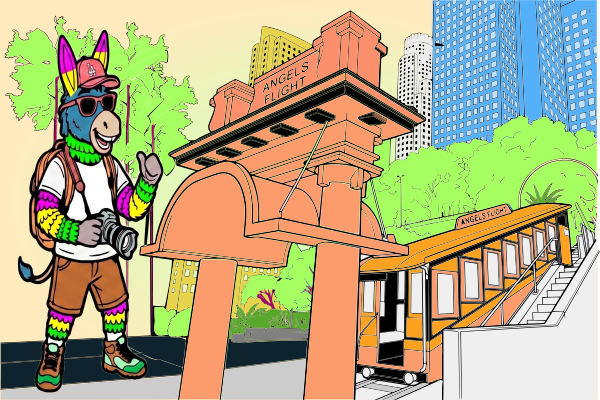
The free walking tour of Downtown LA with MarlonWalksLA (2.5 hours, tip-based) passes Angels Flight, the world's shortest railway, from 1901. Book the free tour or book it in Spanish. More stories: LA history.
Quick answers
What were the Red Cars?
The Pacific Electric Railway, founded by Henry Huntington in 1901. By the 1940s, LA's streetcars ran on over 1,100 miles of track.
When did the last Red Car run?
On April 9, 1961, from Downtown LA to Long Beach. LA then had no passenger rail for nearly 30 years.
What was the first freeway in Los Angeles?
The Arroyo Seco Parkway (now CA-110), opened in 1940 between Pasadena and Downtown LA. It was the first fully grade-separated, controlled-access highway in the United States.
When did rail come back to LA?
In 1990, when the Blue Line (now the A Line) opened to Long Beach along the old Red Car route.